Behavioral Design Patterns
Behavioral patterns are concerned with algorithms and the assignment of responsibilities between objects.
Iterator
It's a behavioral pattern that lets you traverse elements of a collection without exposing the underlying representation.
Explanation
When we are working with objects that are related on another this are express in terms of a Collection, but this are generic by default, iterate over a collection is quite easy if it's in the form of a list, but how about more complex structure like a tree, we need to define a way on how to navigate or traverse this structure.
We would need to couple the traversal within the data structure and create different implementation for each one, but the main reason for collection is a storage of the data, to fix this we decouple the traversal of the data structure into an iterator.
We could have a Depth-first Iterator or a Breadth-first Iterator that handles different types of traversal but the underlying data structure, the Tree, is still the same.
Structure
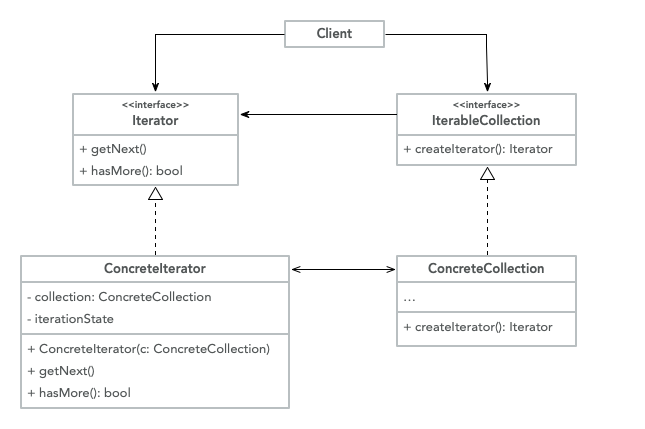
- Iterator: This interface declares the operations (fetch next element, get current position, restart iteration, etc) that are required to traverse a collection.
- Concrete Iterators: Implements the specific algorithm for traversing the collection.
- Collection: This interface declares one or multiple methods for getting iterators compatible with the collection.
- Concrete Collections: Return new instances of a particular iterator class each time the client requests one.
- Client: Work with the collections and the iterators via their interfaces.
Code
public class SQLRows<Type> implements Iterable<Type> {

    private Type[] arrayList;
    private int currentSize;

    public SQLRows(Type[] newArray) {
        this.arrayList = newArray;
        this.currentSize = arrayList.length;
    }

    @Override
    public Iterator<Type> iterator() {
        return new Iterator<Type>() {
            private int currentIndex = 0;

            @Override
            public boolean hasNext() {
                return currentIndex < currentSize
                    && arrayList[currentIndex] != null;
            }

            @Override
            public Type next() {
                return arrayList[currentIndex++];
            }

            @Override
            public void remove() {
                throw new UnsupportedOperationException();
            }
        };
    }
}
When to use
- When you have a complex data structure but want to hide the complexity from clients
- Reduce the duplication of traversal code across the app
- When you need your code to traverse different data structures or if you don't know the structure beforehand
Observer
Defines a subscription mechanism to notify multiple objects that events are happening to the object that they are observing.
Explanation
This pattern is an implementation of the Publish-Subscribe Pattern at the code level, when you have an object that wants to be notified (subscriber) when another object changes its state (publisher), the first object creates a subscription that the second object is going to notify when a particular change happens.
The reason for this is to avoid asking the target object all the time if its state has changed, we can invert the logic and let the target object notify all the objects that are interested in its state, when these changes happened, and what is the new state.
The target object is called a Publisher and the interesting object is
the Subscriber, you can have multiple Subscribers follow a single
Publisher. The publisher keeps track of all the Subscribers and lets them
know when a state changes, Subscribers can also request to be removed from
the Subscriber list.
One real-life implementation for this would be an
Email Newsletter, in this analogy we
the users are the Subscribers and the Newsletter would be the Publisher,
as users we request to be added to the Newsletter and at the same time, we
can request to be unsubscribed from that Newsletter when we no longer have
any interested in them.
Structure
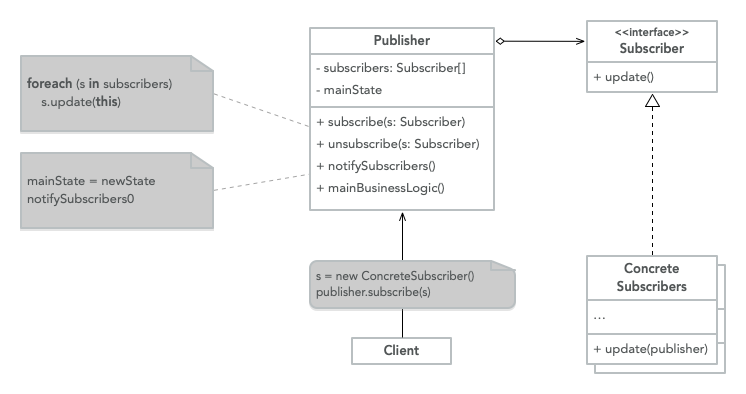
- Publisher: It creates events that are interesting to the other objects, this happens when an event happens or when the object performs some behavior. They contain a subscription infrastructure that let new subscribers join and current subscribers leave the list
- Subscriber: Interface that declares the notification interface. Usually consists of a method that has several parameters that let the publisher pass some events along with the update.
When a new event happens the
Publishergoes through the list ofSubscribersand calls the notification method in the subscriber interface to let them know that a change happened
Code
class Client {
    public static void main(String[] args) {
        Publisher publisher = new Publisher();
        EventSubscriber subscriber = new EventSubscriber();
        publisher.subscribe(subscriber);
    }
}

class Publisher {
    private Collection<Subscriber> subscribers;
    State state;

    Publisher() {
        this.subscribers = new HashSet<>();
    }

    void subscribe(Subscriber subscriber) {
        this.subscribers.add(subscriber)
    }

    void unsubscribe(Subscriber subscriber) {
        this.subscribers.remove(subscriber);
    }

    void notifySubscribers() {
        while (subscribers.hasNext()) {
            Subscriber subscriber = subscribers.next();
            subscriber.update(this)
        }
    }

    mainBusinessLogic() {
        // Something happens that changes the state
    }
}

class EventSubscriber implements Subscriber {
    update(Publisher publisher) {
        // I react to the state
        State state = publisher.state;
    }
}

interface Subscriber {
    update(Publisher publisher)
}

class State {}
When to use
- When you need an object to change when the state of another object changes
- When you need to observe some objects for a limited time or specific cases